
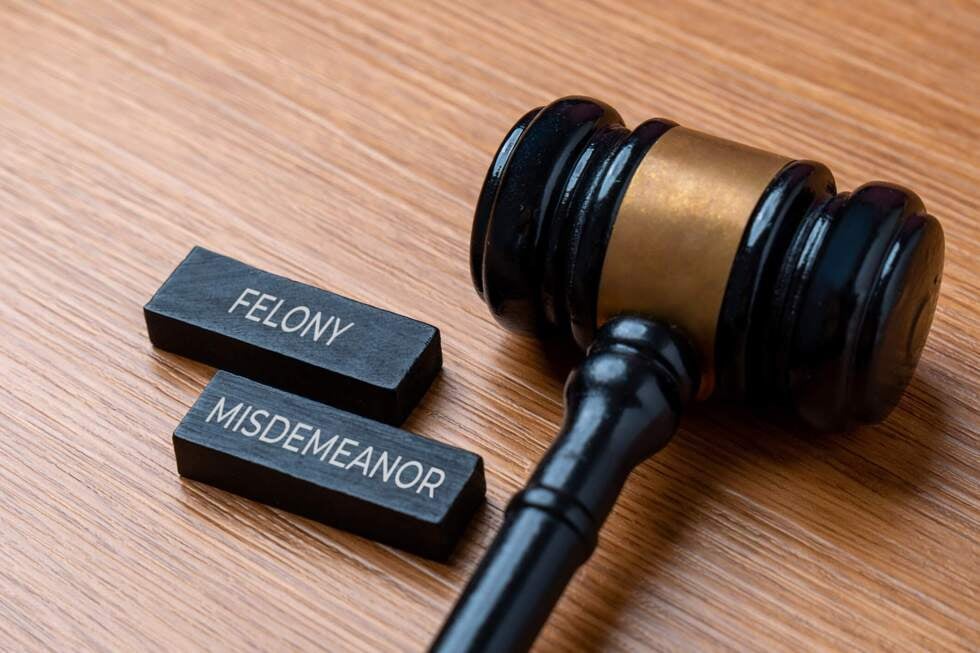
The question almost always comes up within the first few minutes of a consultation: Can this felony charge come down? The honest answer is: sometimes yes, and how you get there depends entirely on when in the process you are, what the charge actually is, and what Nevada's law allows. This post walks through each pathway in the order an experienced defense attorney would actually pursue them, including one quirk of Nevada law that most generic guides never mention.
Nevada's Charge Tiers: Why a "Reduction" May Not Mean What You Think
Most states use a simple two-level system: felony or misdemeanor. Nevada adds a third tier, the gross misdemeanor, which sits squarely between the two. Under NRS 193.140, a gross misdemeanor carries up to 364 days in county jail and a fine up to $2,000. A standard misdemeanor, by contrast, maxes out at six months and a $1,000 fine.
Why does this matter? Because when a defense attorney negotiates a felony down, the first realistic landing point is often a gross misdemeanor, not a standard misdemeanor. That is still a meaningful win: gross misdemeanors generally do not trigger the same collateral consequences as felony convictions (loss of voting rights, federal firearm disqualification, professional license jeopardy), and the record sealing waiting period is much shorter. Understanding the full tier system prevents a client from feeling blindsided when the offer on the table says "gross misdemeanor" instead of "misdemeanor."
Pathway 1: Negotiating Before or During Charges
The earliest and often most effective opportunity to reduce a felony to a lesser charge is at the plea bargaining stage, before a case ever goes to trial. Prosecutors have broad charging discretion in Nevada. They typically file the highest provable charge to gain negotiating leverage, not necessarily the charge they expect to prove at trial.
A defense attorney who intervenes early, reviews the evidence before arraignment, and identifies weaknesses in the state's case creates pressure that can move a felony offer to a gross misdemeanor or misdemeanor plea. Factors that tend to help in these negotiations include:
- No prior criminal history. First-time offenders receive more favorable consideration, both from prosecutors and from judges who must approve any plea.
- A non-violent underlying offense. Felony drug possession, certain theft charges, and low-level property crimes are far more negotiable than charges involving injury to another person.
- Evidentiary problems in the state's case. Suppressed evidence, unreliable witnesses, or chain-of-custody issues give the defense real leverage. This is why filing pre-trial motions is not just procedural housekeeping: it positions the case for better plea terms even if the motion does not succeed outright.
- Cooperation or restitution. Demonstrating responsibility, paying back any victim losses, and showing proactive engagement (such as enrolling in treatment before being ordered to) signals to a prosecutor that the case can be resolved at a lower charge without public safety concerns.
If you have been arrested or charged in Clark County, understanding how Nevada's criminal court process works from arraignment through plea negotiations can help you make informed decisions at every stage.
Pathway 2: Diversion and Specialty Courts
Nevada courts offer diversion programs for certain eligible defendants, most commonly for non-violent, first-time offenders. Successful completion typically results in charges being dismissed or reduced. Clark County's Drug Court program is one example: defendants facing felony drug possession charges who complete a structured treatment and supervision program may see their charges reclassified or dismissed entirely.
Eligibility requirements vary by court and charge. The key points to know:
- Diversion is generally not available for violent offenses or cases involving serious victim harm.
- Acceptance into a program is not automatic; it typically requires prosecutor consent and a court determination of eligibility.
- Failing to complete the program, or picking up a new charge during it, usually results in the original felony being reinstated and prosecuted.
For someone whose felony charge arose from addiction or a mental health crisis, diversion represents the most complete form of relief available: a chance to avoid both conviction and a permanent record.
Pathway 3: Wobbler Charges Under Nevada Law
Some Nevada offenses are classified as "wobblers": crimes that, by statute, may be treated as either a felony or a gross misdemeanor depending on the circumstances. Under NRS 193.130, attempts to commit a Category C, D, or E felony fall into this category. During sentencing, the court has discretion to impose either a felony or a gross misdemeanor sentence.
Common examples of Nevada wobblers include attempted battery causing substantial bodily harm (without a deadly weapon) and certain first-offense elder abuse charges. For wobbler cases, the defense attorney's argument at sentencing directly targets which tier the court should apply. A compelling presentation of mitigating factors, the defendant's background, and the nature of the offense can make the difference between leaving court with a felony on record or a gross misdemeanor.
Pathway 4: Post-Conviction Reduction
If a conviction has already occurred, the options narrow, but they do not disappear. In Nevada, the possibility of a post-conviction reduction depends primarily on the terms of the original plea agreement. A defendant who was placed on probation as part of a felony disposition may be able to return to court upon successful completion of probation, particularly if the original plea bargain specifically provided for a reduction at that point.
This is distinct from record sealing, which is a separate process. A reduction changes the classification of the conviction itself; sealing removes it from public view while the record still technically exists for certain purposes. Both tools can be useful, but they serve different goals and carry different timelines under Nevada law.
It is worth noting what is not generally available in Nevada: unlike California, which has a broad statutory mechanism (Penal Code 17(b)) allowing courts to reclassify wobbler felony convictions to misdemeanors after probation in virtually any case, Nevada does not have an equivalent universal post-conviction reduction statute. This is why what happens before and during the plea stage matters so much here.

What Cannot Be Reduced: Knowing the Hard Limits
Not every felony is reducible, and an attorney who suggests otherwise is not being straight with you. Category A and B felonies, charges involving serious physical injury, most sex offenses, and felony DUI convictions face significant or absolute barriers to reduction. The existence of a prior felony record also dramatically reduces the likelihood that a prosecutor will offer a lesser plea on a new charge.
Understanding what is genuinely possible in your specific case, as opposed to what is theoretically possible in some cases, is one of the most practical things a defense consultation can provide. Early in a case, before evidence is locked in and before a prosecutor has invested time, the options are usually widest.
Why the Classification on Your Record Matters in Nevada
The practical stakes of a felony versus misdemeanor distinction go well beyond the sentence itself. A Nevada felony conviction can affect:
- Professional licensing. Nurses, contractors, real estate agents, teachers, and dozens of other licensed professionals in Nevada face potential license suspension or denial following a felony conviction. A misdemeanor typically triggers a review rather than an automatic bar.
- Firearm rights. A felony conviction results in a federal prohibition on firearm possession under 18 U.S.C. § 922(g). A misdemeanor generally does not, with limited exceptions.
- Housing and employment. Felony screening in rental applications and background checks is near-universal. Even where "ban the box" policies apply, a felony disclosure requirement often remains for certain employers.
- Record sealing timelines. In Nevada, the waiting period to seal a category E felony is five years from discharge; for a gross misdemeanor, it is two years. That difference alone has real consequences for someone trying to move forward.
These collateral consequences are exactly why fighting a charge reduction, even on a lower-tier felony, is almost always worth the effort.
Frequently Asked Questions
Can any felony be reduced to a misdemeanor in Nevada?
No. Reduction is most realistic for non-violent, lower-category felonies (Category D and E) and wobbler offenses. Category A and B felonies, violent crimes, and felony DUI convictions face much higher barriers. Whether a reduction is achievable depends on the specific charge, the evidence, and the defendant's history.
What is the difference between a misdemeanor and a gross misdemeanor in Nevada?
A standard misdemeanor carries up to six months in county jail and a $1,000 fine. A gross misdemeanor carries a maximum sentence of 364 days in jail and a $2,000 fine. Both are less serious than a felony and generally do not carry the same long-term collateral consequences. A felony charge that comes down to a gross misdemeanor is still a meaningful reduction.
Does completing probation automatically reduce a felony in Nevada?
Not automatically. Unlike some other states, Nevada does not have a universal statute allowing post-conviction reclassification after probation. Whether a reduction is possible after sentencing depends primarily on what the original plea agreement specifically provided for.
How does a plea bargain work for reducing a felony charge?
In a plea bargain, the defendant agrees to plead guilty or no contest to a lesser charge in exchange for the prosecution dropping or reducing the original felony. The prosecutor must agree, and the court must accept the plea. Plea negotiations can happen at any point before a verdict, but leverage is typically highest early in the case, when evidentiary issues have not yet been resolved in the state's favor.
Will a reduced charge still show on a background check?
A conviction, even a reduced one, generally appears on background checks until the record is sealed. In Nevada, sealing a record requires a separate petition filed after the applicable waiting period. Successfully sealing a record removes it from public access, though certain agencies (e.g., law enforcement and licensing boards) may still be able to view it in limited circumstances.
What should I do if I've already been convicted of a felony in Nevada?
Review the terms of your original plea agreement to determine whether a reduction was built in upon completing probation. If your record is eligible for sealing, that process has its own waiting periods and requirements. An attorney can review your case and identify which post-conviction options are realistic given your specific circumstances.
If you are facing felony charges in Las Vegas or anywhere in Clark County, the window for the best outcomes is usually early. At Gallo Criminal Defense Las Vegas, James C. Gallo has over 18 years of trial experience and represents clients at every stage of Nevada's criminal court process, from arraignment through post-conviction. Contact our office at (702) 385-3131 for a free consultation, available 24 hours a day, 7 days a week. You can also learn more about your options on our criminal defense practice page.

Comments
There are no comments for this post. Be the first and Add your Comment below.
Leave a Comment